Wednesday, December 2, 2009

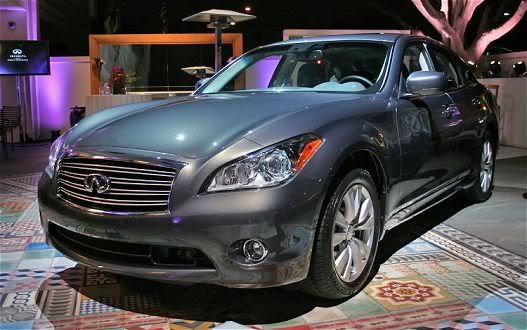
LA Show 2009 Highlights: 2011 Infiniti M


The big star, of course, was the new M, which has been waiting years for a significant update. On the outside, it features Infiniti Essence Concept-inspired styling with round, swoopy bodywork and a new take on the Infiniti grille. Behind it, an updated 330-hp V-6 or 420-hp V-8 can be found and later a hybrid drive system will join the mix. All will be mated to Infiniti's seven-speed automatic transmission and AWD is optional. Also available is a Sport package that will upgrade the brakes, add bigger wheels and tires and tighten up the suspension.

Inside, the M gets a new dash trimmed in wood with silver powder and a new user interface that help to refine Infiniti's previously button-heavy setup. The 16-speaker Bose audio system also employs Bose's noise-cancellation technology to reduce exterior noise while the new Forest Air system replicates the gentle breezes and fresh smells of the forest. You can read more about the new M in our complete First Drive of the prototype version here, then catch it in the metal at your local Infiniti dealer in the spring.

Thanks to: Motor Trend

Tuesday, December 1, 2009

New Car: 2011 Volkswagen Amarok


One of the most highly-anticipated new car arrivals of 2010 has broken cover early with Volkswagen Commercial releasing official images and details of the Amarok pick-up. The first ever European pick-up is set to arrive in Australia in the third quarter of 2010 and go head-to-head with the Toyota Hilux.

Production of the Amarok is set to begin in Argentina in December but Australia's will have to wait until after South America and Europe get dibs on the new ute. Right-hand drive versions are set to go on sale in the UK in September, so Australia can expect a similar timeframe.

"We are looking at the second half of next year to get the Amarok in the country," Anke Koeckler, Volkswagen Australia managing director, told the Carsales Network recently. "We are planning our production because we see huge opportunity and right now we are in negotiation and discussion with the guys from Hannover. And it seems pretty good, which is good because it's a pretty important product for us."

Volkswagen, though, understands the importance of the pick-up in the Australian market and it is believed both petrol and automatic versions of the Amarok are under development to better cater for local demands; however officially neither of those two features have been confirmed.
What has been confirmed is that the Amarok will launch in dual cab form with the choice of two diesel engines. The first is a single turbo unit rated at 90kW and 340Nm and a twin-turbo variant that will produce 125kW and 400Nm.

Both engines will be mated to a six-speed manual gearbox and there will be a choice of rear-wheel drive 4x2, part-time 4x4 and fulltime 4x4 using a modified version of the 4MOTION system from the Touareg.

Although the company has yet to release fuel consumption figures it claims that thanks to an 80-litre fuel tank the Amarok will have a range of over 900km.

Measuring 5.25m long, the Amarok will have a payload capacity of up to 1100kg and be capable of towing up to 2800kg. The firm has also revealed there is 1222mm load space between the rear wheel-arches to optimise load carrying capability.

The Amarok will come fitted with an electronic differential lock (EDL), off-road ABS (anti-lock braking system), hill decent assist and hill hold assist for improved off-road performance.
Thanks to: Car Point

Hot News: BMW/PSA's Front-Drive 1-Series


BMW and PSA Peugeot Citroën are set to extend their joint venture operations to include a new small car platform, which could be used to create a front-wheel-drive 1-series as well as the next generation of Minis.

Already involved in the joint design and production of four-pot engines for Mini and PSA models, the two firms are working on a deal to build a new modular front-wheel drive platform.
The planned structure will underpin the next-generation Mini range, as well as successors to the Citroën C3 and C4, Peugeot 308 and the forthcoming Peugeot 208.

“It’s no secret that we have been seeking to extend our joint venture operations. In the end we decided to build on our successful relationship with Peugeot,” said a BMW source. The decision is scheduled to be made public early next year.

But the biggest change would involve the platform’s use in the 1-series. BMW officials have hinted that future incarnations of the 1-series could sit on the same basic structure as the 2013 Mini.

“Nothing is concrete at this stage but discussions are on-going about whether or not BMW should break with the tradition of rear and four-wheel-drive cars,” said a BMW source. “For many in this company it is a taboo subject. But we have to be realistic with the targets we have set ourselves for fuel consumption and emissions, and they clearly favour a front-wheel-drive solution for 2018.”

The platform is said to centre on a front-end module, including the entire engine bay, front suspension and bulkhead, to which each car maker will attach its own rear end. That solution would allow BMW to retain the Mini’s multi-link suspension.
Thanks to: Autocar

Hot News: The Future of Ford Focus Revealed


The man who oversees Ford’s global family of C-segment cars has given a tantalising glimpse of the Focus of the future.

Speaking to Automotive Engineer magazine, Gunnar Herrmann predicted that by the end of this decade the manual transmission may disappear from the range altogether. He also raised the possibility of a turbocharged and electrically assisted two-cylinder Focus.

Herrmann said the third-generation Focus will be based on a version of the EUCD platform that underpins the current S-Max and Mondeo.

One if the biggest gains from this will be the adoption of an electrical architecture that will allow the ‘plug and play’ introduction of advanced, executive-level features on Focus-size models.
The car’s structure will still be made from steel, but more use will be made of hot-formed and boron steels, which are lighter and stronger than conventional steels.

Hermann also revealed that stop-start systems will be “virtually standard” within five years, and that small-displacement two and three-cylinder turbocharged engines will be available before the end of the decade.

Electrical assistance will be offered to cut emissions and improve acceleration.
Herrmann suggested that dual-clutch transmissions — which aid fuel-efficient driving — could result in manual gearboxes “disappearing completely” by 2020.

However, it is the introduction of advanced electrical systems that will make the biggest difference to future Focus drivers.

Driver-adjustable adaptive dampers, lane departure warning systems and traffic sign recognition will all become much more common. Electric power steering systems could incorporate an anti-torque steer feature, too.

In-car internet is on the way, as are more sophisticated connectivity systems for mobile phones as Focus-family cars aim to offer the electrical sophistication of today’s premium luxury models.
Thanks to: Autocar

New Car: 2011 Infiniti M


This is Infiniti’s new flagship saloon, which arrives in the UK next September.

The Infiniti M will be sold in V6 petrol and diesel forms, followed in 2011 by a version fitted with a new high-efficiency hybrid transmission.

Infiniti — Nissan’s luxury division — is pitching the M as a direct rival to the BMW 5-series and Mercedes E-class but won’t release any pricing information until nearer to the car’s launch.
Like the other cars in the Infiniti range, the M is based on the company’s rear-drive FM (front-midship) platform, which places the engine behind the line of the front axle. The car uses double wishbone suspension at the front and a multi-link rear axle and it has speed-sensitive power steering.

The M’s styling was previewed at the Geneva show earlier this year and has very low aerodynamic drag, with a Cd rating of 0.27. Although the structure is a steel monocoque, the doors, bonnet and bootlid are made of aluminium.

Infiniti designers have made huge efforts with the quality of materials in the interior and have even used university researchers to engineer new soft-feel plastics technology. Infiniti also says the 2.9m-long wheelbase is longer than most rivals’ to help ensure “plenty of room for five adults”.

The first model to go on sale will be the M37. It is powered by a 3.7-litre V6 petrol engine that is good for 316bhp and 266lb ft. All M models get a seven-speed automatic and steering wheel paddles. The engine and transmission response can be set by driver to Standard, Eco, Sport and Snow modes.

High-end features available on the M include Blind Spot Intervention (which can automatically steer the car away from danger), Active Noise Control (which cancels out low-frequency engine noise), Forest Air climate control (which uses pulsated air and fragrances to help relax passengers) and Dynamic Cornering Assistance (which uses subtle individual brake control to reduce steering effort during tight manoeuvres).

Active four-wheel steering will also be an option on certain M models.
Thanks to: Autocar

Spied: 2011 BMW M3


The high(er)-performance GTS model isn't the only update for the M3. Subtle cosmetic upgrades are coming to the standard model, too. Our daring spy photographers just sent over these images of a lightly camouflaged example in Europe. The black tape spells out what's new: the taillights.

Affixed with LEDs, the new lights are part a slight refresh. Also expected is an updated interior. We understand a similar update is coming to the standard 3 Series, but it will include revised front and rear bumpers.
Thanks to: Motor Trend

New Car: 2011 Audi A8


The 2011 Audi A8 launches in North America about this time next year, a few months after the summer '10 release in Europe. While Western Europe gets a 3.0-liter TDI V-6, a 3.2-liter FSI V-6, and 4.2-liter turbodiesel and gas direct-injection V-8s, we get the car only with that latter engine, upgraded to 372 horsepower and 328 pound-feet.

The direct injection allows a 12.5:1 compression ratio and Audi's "modular efficiency system" converts kinetic energy to electric power, buffered in the battery, upon deceleration. A computer monitors actuators for the ideal distribution of the heat flows between the engine, transmission and interior. At cold start, the system uncouples the engine temporarily from the cooling circuit to shorten the warm-up phase with its high friction losses.

The 4.2 may be a short-termer, however. Audi is preparing a supercharged 4.0-liter V-8 gas direct-injection engine to supplement, for the time being, the 4.2. While we don't have a timeline, an insider assures us it comes very soon after the luxury flagship's launch. Also rumored to be in the pipeline is a hybrid model.

The power is transmitted through a new eight-speed automatic to the quattro all-wheel-drive system. Audi claims a 0-62 mph time of 5.7 seconds and an electronically controlled top speed of 250 kp/h, or, in the automaker's exactitude, 155.34 mph.

The dynamic shift program now networks with the optional MMI navigation plus system to anticipate curves in its gearshift strategy and avoid unnecessary gear changes. Taking a swipe at BMW's and Mercedes' modern gearshifts, the A8 comes with a selector lever on the center tunnel, shaped like the thrust lever of a yacht. You can change gears with a quick tap of the lever, or use the rocker switches on the steering wheel.
Thanks to: Motor Trend